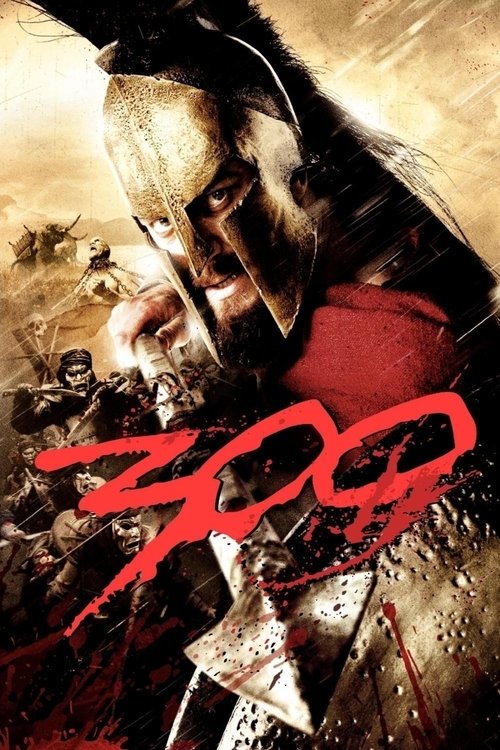
In 480 BC, the Persian Empire — the largest the world has ever seen — marches toward Greece with an army estimated at over one million soldiers. King Xerxes sends a messenger to Sparta demanding submission: earth and water, the traditional tokens of surrender. King Leonidas’s response becomes the stuff of legend: he kicks the messenger into a bottomless pit with a single word — “Sparta.”
Defying the corrupt Oracle and the political machinations of a traitorous council, Leonidas assembles a personal guard of exactly 300 Spartan warriors — each one a perfectly trained killing machine raised from birth for combat. They march north to the narrow coastal pass of Thermopylae, “The Hot Gates,” where the terrain negates the Persian advantage in numbers and forces Xerxes’ army into a narrow chokepoint.
For three days, the 300 hold the line against wave after wave of Persian infantry, cavalry, archers, and even Xerxes’ elite Immortals. With their iconic bronze shields forming an impenetrable phalanx, the Spartans fight with superhuman discipline and ferocity while Leonidas trades verbal blows with the god-king Xerxes himself. Back in Sparta, Queen Gorgo wages her own political battle to send reinforcements. Adapted from Frank Miller’s graphic novel with a revolutionary visual style, 300 transforms ancient history into a visceral, larger-than-life spectacle.
Director & Cast
Director: Zack Snyder — using a nearly full greenscreen environment and innovative color grading, Snyder brought Frank Miller’s graphic novel panels to life with stunning fidelity.
Cast: Gerard Butler as King Leonidas, Lena Headey as Queen Gorgo, David Wenham as Dilios, Dominic West as Theron, Rodrigo Santoro as Xerxes, and Michael Fassbender as Stelios.
Behind the Scenes
The entire film was shot in a Montreal warehouse using greenscreen backgrounds, with environments digitally painted in post-production. Gerard Butler and the cast underwent an intense eight-week physical training program. The film’s distinctive desaturated color palette with occasional bursts of crimson became one of the most imitated visual styles of its era. It earned $456 million worldwide on a $65 million budget.