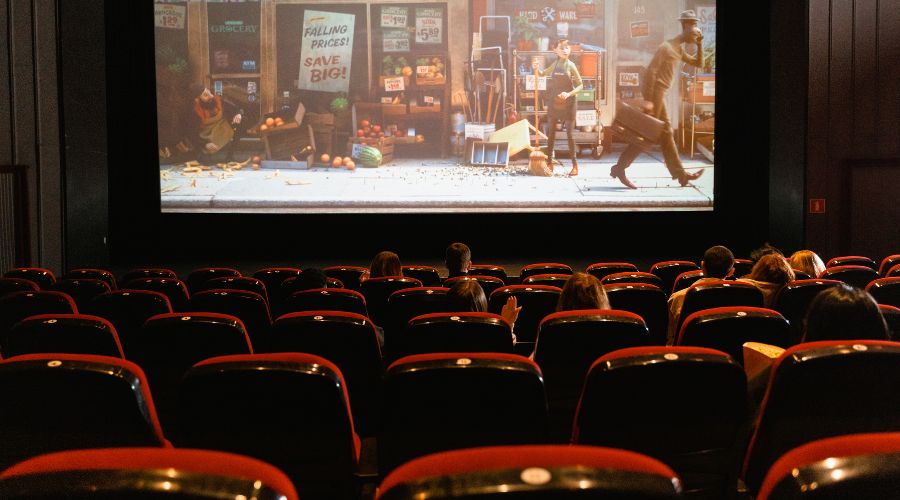
People were already becoming homebodies before the pandemic forced everyone to stay inside. At-home entertainment, spurred by an ever-expanding array of streaming services and increasingly sophisticated TV set-ups, removed the need to leave the house.
According to Paul Hardart, director of the Entertainment, Media and Technology Program at New York University’s Stern School of Business, movie theater attendance was already plateauing before Covid.
Meanwhile, ticket prices have been rising, with the average ticket price in the US rising from $9.16 in 2020 to an estimated $16.08 in 2025 as venues adjust to higher operating costs, shifting demand, and the growing appeal of premium-format screenings.
The pandemic only exacerbated the problem. When movie theaters closed due to lockdown orders, studios turned towards streaming services to debut their films. But as we look toward 2026, the industry has realized that neither streaming-only models nor traditional theatrical runs are sustainable in isolation.
In 2021, the simultaneous release model was a survival tactic. By 2026, it has been replaced by a ruthless “tiering” strategy. Studios now rigorously separate content into “Living Room” fillers and “Cinema” events.
This shows that even with the movie industry returning to normality, streaming services are facing a profitability wall. Warner Bros. Discovery and Disney have shifted focus from raw subscriber growth to retention, battling high churn rates. Disney+ aims to hit 284 million subscribers by 2026, but the cost of acquiring those users has skyrocketed.
The future of cinema remains uncertain, filled with both challenges and opportunities for studios, theaters, media distributors, industry workers, and consumers.
What will the movie theater experience be in 2026?
Movie theaters are not yet on the verge of extinction. But to survive, they’ll need to adapt.
For Eric Handler, an analyst at Roth Capital Partners, the recovery has lagged behind expectations, but 2026 appears robust. The key is to make a trip to the theater a unique, customized event for consumers.
“Theaters can reinvent themselves by thinking about how they can personalize experiences,” experts say. That involves things like better food, more comfortable seats, and the possibility to privatize a room. We are already seeing chains like B&B Theatres introducing pickleball courts and bowling alleys into their complexes to “extend the stay.”
But sometimes that won’t be enough. If you’ve replicated a high-quality film watching experience at home, with a good sound system and large screen, it’s going to be difficult for movie theaters to convince you that you need to go out and spend money on overpriced popcorn.
That’s where blockbusters come in. According to analysts, people want to see highly anticipated, high-budget films with exceptional special effects and globally beloved stars on a massive screen. Increasingly, theaters will specialize in those types of movies, while studios will prefer a streaming-only release for films that people have no incentive to leave their house for.
This has led to the rise of Dynamic Pricing. Just as Disney parks have implemented demand-based pricing, movie theaters in 2026 are actively testing variable pricing models—charging premium rates (upwards of $25) for opening weekend seats of massive hits like Avengers: Doomsday, while discounting tickets for smaller dramas to fill seats.
What does the ‘Animation War’ mean for the future of cinema?
We witnessed the power of anticipation, high budgets, and beloved stars with ‘Barbenheimer.’ In 2026, we are seeing a similar phenomenon with the “Battle of the Brands.”
The summer of 2026 is slated to be a clash of titans. Toy Story 5 (June) and Shrek 5 (originally targeted for July, potentially shifting to December to avoid casualties) represent the new “safe bet” economy. Studios are no longer taking risks on original IP for theatrical slots; they are weaponizing nostalgia.
Toy Story 5 brings back Woody and Buzz, banking on multi-generational affection. Shrek 5 revives a franchise dormant for over a decade to capture Gen Z’s ironic love for the character.
Avengers: Doomsday, slated for May 2026, brings Robert Downey Jr. back to the MCU, a desperate but calculated move to recapture the magic of 2019’s Endgame.
The buzz surrounding these releases shows how streaming could never replace theatrical moviegoing. There are various reasons for the excitement—including the communal nature of seeing these characters return.
A major component of the potential success is the “eventization” of these films. Just as Barbie encouraged pink outfits, Super Mario Bros. 2 (April 2026) is expected to drive interactive screenings where audiences dress up, effectively turning the cinema into a convention hall.
The effort and anticipation people put into planning and seeing these franchise pillars shows why the future of cinema may still be alive.
Is streaming profitable?
As movie theaters specialize in either blockbusters or niche indie experiences, the likelihood is the future of cinema will see a lot more movies being released via digital, direct-to-consumer distribution. For both studios and streaming services, the most important challenge is figuring out how to sustain a profit.
“What’s happening is that you have really high customer acquisition costs,” explains industry analysts. The “hit-and-run” consumer—who signs up for The Last of Us Season 2 or Harry Potter on Max and then cancels—is the industry’s biggest enemy.
To counteract this, streaming services need to use data-driven insights to learn about and shape consumer behavior. By 2026, the focus has shifted entirely to Ad-Supported Tiers (AVOD). These tiers are more lucrative than premium subscriptions because they generate dual revenue streams.
“We can use that to further enhance our decision making on what content we produce,” experts add. “I think data has a role in every aspect of the supply chain.”
In 2026, the line is drawn: The theater is for the Spectacle—the $200 million franchise film that demands a crowd. The home is for the Story—the drama, the comedy, and the reality show that sustains the monthly subscription. The middle ground has vanished.
Refernces
- https://www.statista.com/statistics/687699/amc-theatres-ticket-price/
- https://www.imdb.com/news/ni64703243/
- https://globaltribune.net/streaming-services-and-movie-theaters-the-film-industry-is-in-crisis
- https://variety.com/2025/film/news/movie-theaters-comeback-screens-shut-down-box-office-slump-1236347993/
